Looking for John Deere SF-RTK, John Deere RTK subscription, or a John Deere RTK base?
These are related, but they are not all the same thing. SF-RTK is Deere’s own correction service. We provide an independent RTK correction source for compatible John Deere equipment using NTRIP / RTCM3 over 4G or internet. That means you can either use a network RTK subscription or install your own on-farm RTK base station, depending on what suits your farm best.
Two ways to get John Deere RTK on your farm
Most farms searching for John Deere RTK are trying to choose between an independent correction subscription and their own base station. The right answer depends on farm layout, machine numbers, internet availability, whether you want a local correction source, and whether you are running a John Deere-only fleet or a mixed fleet.
1) John Deere RTK subscription
Best if you want the simplest route into RTK. Your machine connects to a correction stream over 4G or internet and receives RTK corrections without you having to install and maintain a permanent base on your own site.
- Fastest route to a working setup
- No base to mount, power or secure
- Good for farms wanting minimum hardware on site
- Useful where machines move between blocks and farms
2) John Deere RTK base station
Best if you want your own local correction source on the farm. We supply the base hardware and included PoE adapter. Once installed with suitable mains power and Ethernet or Wi-Fi, we remotely configure and calibrate it against the Ordnance Survey network.
- Independent RTK source on your own farm
- Remote configuration and calibration after installation
- Suitable for permanent farm setups
- Can support multiple compatible machines
3) Mixed fleet flexibility
Many farms are not purely John Deere. If your equipment supports the required correction format and connection method, the same RTK setup can often serve John Deere alongside other brands, which is useful where different tractors or receivers share the same land base.
- John Deere plus other compatible brands
- One farm RTK strategy instead of brand silos
- Simpler management across the fleet
- Clearer support path when expanding later
Should you choose a John Deere RTK base station or a John Deere RTK subscription?
This is the question most buyers are really asking. The answer is usually operational rather than technical. A subscription is normally the easier starting point. A base station makes sense when you want an RTK source physically on your farm and you are prepared to mount and power it properly.
Choose a John Deere RTK subscription if:
- You want the simplest way to get John Deere RTK working.
- You do not want to install permanent hardware on a building or mast.
- You want to avoid the extra job of managing a base station on site.
- You want a farm-wide correction solution without per-tractor dealer-style charging.
- You need something quick to deploy for drilling, planting, spraying or strip-till work.
Choose a John Deere RTK base station if:
- You want your own local RTK correction source at the farm.
- You prefer owning the hardware and controlling where it is installed.
- You have a good mounting point, suitable mains power and either Ethernet or Wi-Fi; the PoE adapter is included, with battery and 4G retained as backup.
- You want a longer-term permanent RTK setup.
- You are building a broader precision farming setup around your own infrastructure.
John Deere Mobile RTK and compatibility
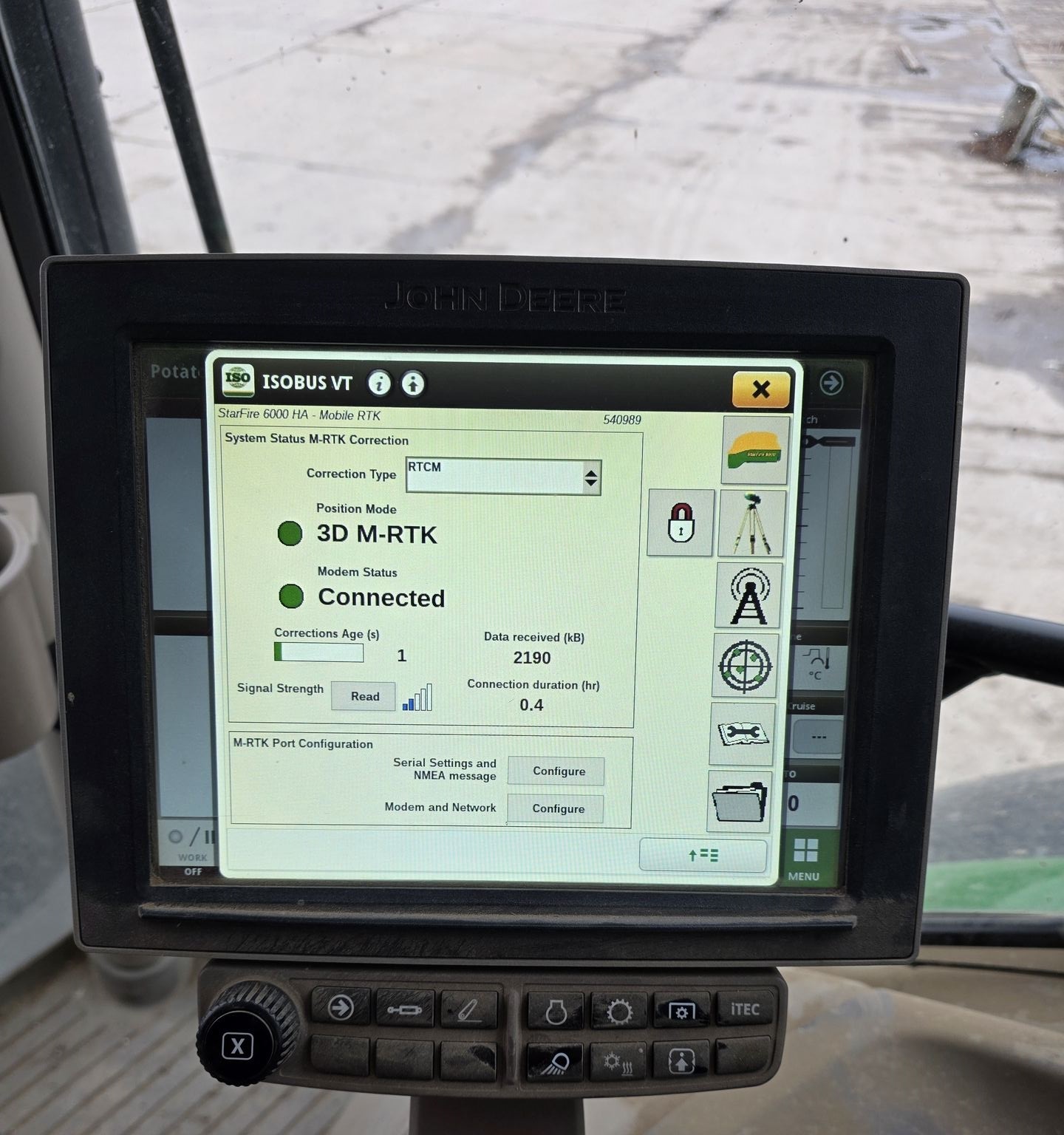
The key point is not just whether the tractor is John Deere. What matters is whether the receiver, display and modem arrangement supports Mobile RTK / NTRIP correction input. That is why we check the actual machine setup before supply.
What we need from you
- Receiver model
- Display model
- Whether you already have a modem / internet connection on the machine
- Whether you want subscription only or a supplied base station
- Whether you are running only John Deere or a mixed fleet
What we confirm
- Whether your John Deere equipment can take NTRIP corrections
- What connection method is needed
- Whether a base-only, subscription-only, or full package is the right route
- How to enter mountpoint and login details
- What support is needed to get the machine live
How a John Deere RTK base station deployment works
This is not a box-shifting exercise. The point is to get you to a working RTK setup with minimum friction. That is why we supply a complete, integrated base and configure it remotely after installation rather than leaving you to assemble everything from scratch.
Step 1 — We check and prepare the hardware
We confirm the machine compatibility and supply the complete base hardware with its PoE adapter, so you are not starting from a pile of separate parts.
Step 2 — You install the base
Mount the antenna properly above the roofline or on a suitable structure, with a clear sky view and stable fixing. Connect the included PoE adapter to suitable mains power and provide Ethernet or Wi-Fi; battery and 4G backup are built in.
Step 3 — We configure and calibrate remotely
Once installed, we remotely configure the base and calibrate its position against the Ordnance Survey network.
Step 4 — Machine setup and work
Enter the NTRIP details on the John Deere machine and confirm it is accepting corrections. You then have a practical centimetre-level RTK workflow for guidance, controlled traffic and repeatable lines.
Why farms search for an independent John Deere RTK subscription
A lot of farms are not looking for theory. They are looking for a practical correction source that works, is clearly priced, and is not tied to one machine brand if the farm changes later.
One farm setup
Instead of thinking in terms of separate correction contracts for each machine, you can build an RTK setup around how the farm actually operates.
Remote setup and calibration
Once the hardware is installed, we remotely configure the base and calibrate it against the Ordnance Survey network, removing much of the trial-and-error from setup.
Direct support
When you are trying to get a tractor connected, you need someone who understands the real setup on the farm rather than a generic support script.
Frequently asked questions about John Deere RTK
These are the exact questions people usually type into Google before they ring or email.
Can I use an independent RTK subscription on John Deere equipment?
Yes, if the receiver and display support Mobile RTK / NTRIP correction input. We check compatibility before supply rather than guessing from the tractor badge alone.
Do I need a John Deere RTK base station or just a subscription?
Most farms start with a subscription because it is simpler. A base station makes more sense when you want your own permanent correction source on the farm and have a proper installation point.
Is this the same as John Deere SF-RTK?
No. SF-RTK is Deere’s own correction product. Our service is an independent RTK correction solution delivered over NTRIP / RTCM3 for compatible equipment.
Can one subscription cover more than one tractor?
Our setup is intended to cover the farm rather than charging per tractor, subject to the agreed system and usage. That is one of the main reasons farms look for an independent RTK subscription.
Can I run John Deere and other brands from the same RTK source?
Often yes. Where the machines support the required correction format and connection method, a single RTK source can work across a mixed fleet.
Do you configure the John Deere RTK base for me?
Yes. After the base is physically installed with suitable mains power and Ethernet or Wi-Fi, we remotely configure it and calibrate its position against the Ordnance Survey network. The PoE adapter is included, with battery and 4G backup built in.
Need the right John Deere RTK setup for your farm?
Tell us your John Deere receiver, display and whether you want a subscription or a base station. We will point you at the right route instead of selling you the wrong one.